


In this episode! The first of many, were we drill-down to a human level to discover what it’s really like to finally be switched-off to the sound of music in the lounge rooms of many ordinary TV goers.
Placed between the Baby Boomers and the Millennials, Gen-X as a cohort of young people growing up in the 70’s witnessed the launch of Countdown (Australian TV series screened on the ABC, hosted by Ian Molly Meldrum) and the birth of music video.. with the launch of MTV seven years later, in August 1981.
The Buggles newly released music video, Video Killed the Radio Star was used to full affect in their launch into the international music market in 1981 and ranked top 10 in Australia, Canada, Germany, New Zealand and South Africa.
“I Want My MTV” was one of the most iconic advertising slogan for MTV in the early 1980s, encouraging cable subscribers to demand the channel, and became famous through its inclusion in the Dire Straits song “Money for Nothing“, featuring Sting’s vocals.
It signified the beginning of the music video era and a cultural shift, with variations like “I Am My MTV” emerging later for a new generation. The slogan has been revisited, with later versions like “I Am My MTV” reflecting shifts in identity and media consumption, connecting to platforms like Tumblr and Vine
During that time, Gen X were bombarded with a plethora of pop and youth culture options and phenomena, from post punk pop-rock, New Romantics, catchy American guitar pop and joyously flamboyant eccentrics like Cyndi Lauper, Dead Or Alive, Culture Club and Eurythmics.
The MTV Revolution
Although it is not widely recognised, Countdown also had a strong international influence, because it was one of the first TV shows in the world to promote the regular use of the music video as a major part of its programming, though not long after the launch of MTV in America in 1981 the popularity of Countdown started to lose momentum and by the mid-1980s, Australian musical acts were making the transition from regular live performances to making promotional video clips.
The key turning point of the MTV revolution was the explosion of Michael Jackson’s monster success ‘Thriller’ and it’s immensely popular and influential videos, ‘Billie Jean‘, ‘Beat It‘ and ‘Thriller‘ in 1982-3.
Jackson’s popularity at the time was a worldwide hype equal to the greatest of the greats, such as Elvis Presley, The Beatles, The Rolling Stones, Elton John, David Bowie and ABBA. Much was made at the time of the video for the first single, ‘Billie Jean’ which was cutting edge at the time with its plethora of visual ‘ideas’ such as the footpath squares illuminating each time Michael Jackson set foot on them, dancing down a path reminiscent of the yellow brick road in ‘The Wizard of Oz’, a beloved Jackson preoccupation.
‘Beat It’ was just as huge a phenomenon as ‘Billie Jean’ was, but in a dramatically different way. While ‘Billie Jean’ was a regretfully romantic song, a cautionary tale of fatally flawed love, ‘Beat It’ seethed with foreboding and tension, was much more rock and aggressive mixed with dance beats and did what no other song had ever done before. It brought underground gang culture and street violence into the living rooms and onto the radios of mainstream America by means of its lyrics and video, its imagery squarely centred in such themes.
MTV championed these videos, played on huge rotation around the world and along with Michael Jackson is credited with bringing about the commencement of the MTV revolution. The third instalment in Jackson and MTV’s video revolution was the video for his song, ‘Thriller’. Not only did it provide iconic costumes, imagery and dance choreography but it pioneered the idea of the music video as short film, with ‘Thriller’ being presented as a 12-minute video, about half of which was the music clip itself and the other half was horror tribute mini-movie that was available to purchase as a stand alone video cassette. ‘Thriller’ set a huge precedent as to the power of the music video and again, proved insanely popular.
INXS’s Long, Steady March
On August the 1st 1981, the day that MTV aired its first video, the Buggles’ ‘Video Killed the Radio Star‘, INXS was still a band on the move in Australia having just finished recording their second album, Underneath the Colours. But it wouldn’t take long before INXS and MTV collided – and the results were era-defining. In the pre-internet age, there was no better outlet for mass consumption of music than MTV. No MTV… no Prince! No Madonna! No Men at Work! No INXS.
INXS may not have been the ‘best’ Australian band to come out of the early 1980s – Cold Chisel, Midnight Oil, AC/DC, the Angels, Icehouse and others could all lay claims to that tag, but INXS would become the most image conscious, the most marketable. And probably the most successful.
David Fricke, a highly rated writer for American Rolling Stone, summed up Hutchence as a fascinating, seductive and tormented creature.
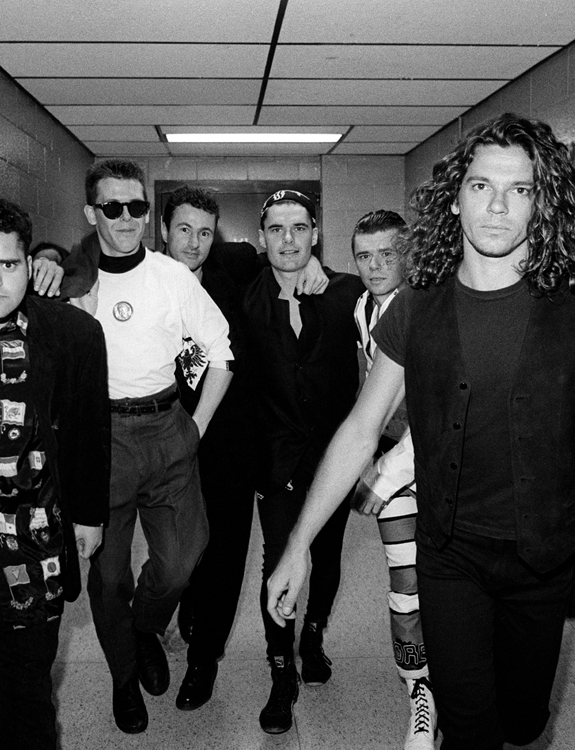 Shot backstage before the show for the 1988 KICK Tour. Chris Murphy, who had absolute faith in the band knew the band’s destiny lay offshore. While he set to work shopping for an international record deal, he commissioned the guys in the band to find the right producer for their next record, the big album that had the potential to break them globally. It was also a musical road trip for the band, as they drifted through America and then England, meeting with various production contenders and soaking up the different music scenes – new wave, electro-pop, hip-hop – that had emerged after punk had crashed and burned. All would leave their mark on the INXS sound.
With record deals now in place with Atlantic subsidiary Atco (for North America) and Polygram for the UK and Europe, INXS’s international odyssey formally began in spring 1983. Gary Grant, who’d worked alongside Murphy in Sydney, set up an office in New York; he’d be their point man in America. On the wall of the office was a map of the world; over time, flags would be added to the map indicating where the band was making inroads. ‘In the early’80s in America,’ Murphy explained, ‘you had fat, rich guys playing stadiums…they were just getting fatter and lazier. I knew that it was going to change – quickly. I knew that if we attacked it, we’d be part of that. But I knew we had to work hard.’
Murphy’s bolshie theory was confirmed when he attended a radio industry conference in the US. A keynote speaker predicted that new wave was the next big commercial movement, set to take over North America, the biggest music market on the planet. Murphy was so inspired that he called a band meeting for 6 a.m, as soon as he stepped off the plane at Mascot. We’re going to America, like, right now,’ he told the sleepy band members. ‘You see, there’s this thing called MTV.’ It was ‘The One Thing’ that kicked off the long-standing relationship between INXS and MTV. Soon enough, INXS would shoot the first of many distinctive videos with Melbourne director Richard Lowenstein, who became another key player in the band’s rise to fame. Notably the videos for ‘Original Sin‘ and ‘I Send A Message‘ from 1984’s ‘The Swing’ were filmed in Japan and directed by Yasuhiko Yamamoto. Both videos use very confronting, seductive, cultured but accessible imagery, representing Japanese culture in all its strangeness and beauty with INXS in the middle of it, as though offering a secret, mysterious language of unknown imagery.
‘Original Sin’ presents INXS riding on motorbikes at night in Tokyo in long, dark grey coats, Hutchence in sunglasses. INXS’s songwriting was at a peak here, with brooding, moody guitars and keyboards, a good, meaty bass and punchy drum part and the seductive, captivating images of the video were highly effective in drumming home INXS’s message. So too was the video for next single from ‘The Swing‘, ‘I Send A Message’, starting with Hutchence singing on a tv in the middle of a Japanese shrine in a temple, he and the band soon appearing performing in front of the shrine, with some evocative footage of a geisha and a troupe of monks added to the equation. Add an energetic performance from Michael Hutchence and the band and again, you have a sublime, hypnotic video that uses Asian culture and imagery in a highly unique way, especially for the era, that proved incredibly effective in pushing INXS’s brand and image. Immensely popular third single, ‘Burn for You’, took a vastly different turn and returned to good old bogan Australia.
Well, not quite, in all truth it was more arty, leftie, progressive Australia. This time they took to Queensland with a loose narrative of INXS touring its regional centres, concluding in London, as if reaching a pinnacle of success. Hutchence had the idea after seeing a Richard Lowenstein video he did for Hunters and Collectors shot in Queensland, asked Lowenstein if he could shoot it for INXS and thus the video was born out of this. But the result was a balmy, summery, joyful celebration, depicting INXS partying with other trendy, arty mid-80’s people in their twenties in the choruses while Hutchence was shown running through the jungle, blinding light flickering brilliantly between the trees at times during the verses.
While certainly an ad for Australia and all its good living on one level, moreover it was a celebration of that life and the innate freedom involved in it. Using the popular 80’s technique of texta coloured frame sequences and stop-motion passages of Michael Hutchence dancing, ‘Burn For You‘ proved a very successful amalgamation of these new visual effects and techniques and the lifestyle ethos as presented. This made an immense contribution to the song’s success, enormous popularity and longevity.
Popular Culture
MTV and A Nightmare on Elm Street pt3: Dream Warriors (1987) were deeply connected through heavy cross-promotion, including Freddy Krueger’s appearances in MTV promos and the film’s iconic theme song, Dokken’s “Dream Warriors“, which heavily featured Freddy in its music video, making the movie a major pop culture event for the music-focused network and its horror-loving audience.
Superstardom
In the Northern Hemisphere, the video age had seen Duran Duran catapulted into the mainstream with the introduction of the 24-hour music channel MTV. Many of Duran Duran videos were shot on 35 mm film, which gave a much more polished look than was standard at the time. They also collaborated with professional film directors to take the quality a step further, often teaming up with the most prominent music video director of the 1980s; Australian film director, Russell Mulcahy.
Although Roxy Music and its experimental art-school approach to making music have been lauded as the cult indie group The Smiths, grunge gods Nirvana and overlords of stage-camp Scissor Sisters (all for different reasons), it is arguably the decadence of the band’s carefully cultivated peacock-ery that propelled it to superstardom, prophesying with a wink the sleeky manufactured pop culture that dominated the 1980s.
Russell Mulcahy’s career began as a film editor for Australia’s Seven Network. After making a number of film clips for Australian bands, including Dragon, he relocated to the UK around 1976, Mulcahy joined Jon Roseman Productions International and made successful music videos for several noted British pop acts—his early UK credits included The Sex Pistols, XTC’s “Making Plans for Nigel” (1979), The Vapors’ hit ‘Turning Japanese‘ and his landmark video for The Buggles’ ‘Video Killed the Radio Star‘ (1979).
In 1978, he went to the United States (for Roseman) and directed videos for The Cryers and Candi Staton – where he first used the “jump cut” – under producer Paul Flattery. Other Mulcahy innovations included spot color, body painting, glass matte shots and faux widescreen aspect ratio (first used on his Ultravox and Rod Stewart videos) which have all become standards for the genre. By the mid-1980s Mulcahy was directing videos for some of the most successful pop-rock acts of the period including Culture Club, Human League, The Tubes, Elton John, Ultravox, most of the major hits of Duran Duran, Spandau Ballet, Kim Carnes, Bonnie Tyler, Rod Stewart, Billy Joel, The Motels, Supertramp, Kenny Loggins and The Rolling Stones.
If you appreciate this type of in-depth, independent, journalism, then please consider donating to keep this blog rolling! Your support is crucial and much appreciated. Many thanks to those of you who have already contributed.




Comments