

Equally big on image as much as musical substance was the gender bending phenomenon that came out of the UK, primarily through the likes of Eurythmics, Human League and Culture Club. With the lead single from their second album, ‘Sweet Dreams‘, Eurythmics produced a video as equally iconic as the song itself, with singer Annie Lennox’s striking, androgynous orange dyed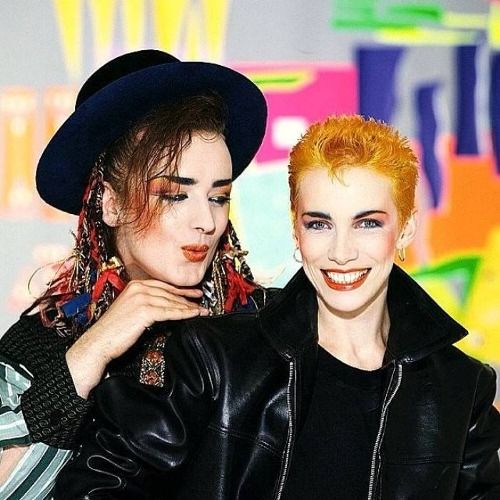 buzz cut and in-your-face on screen persona creating shock waves around the world, the effect of which was felt for decades. Meanwhile in Culture Club, Boy George brought the intense essence of London underground club queer into the mainstream with angelically sugar sweet songs, which was quite an extraordinary achievement. There was amusing confusion about his and Annie Lennox’s sexuality, with people thinking Lennox was a cold lesbian banshee and actually believing Boy George was straight.
One thing music video did in the 1980’s was bring street life, alternative subcultures and bourgeois lifestyle representations and fashions into living rooms like never before sometimes combining all three, creating a visual language, series of references and conversation about such things in a way that was new for the world. Culture Club’s frequently colourful and lively videos featured sophisticated, cutting edge London fashions, both gay and straight, none less striking than George’s androgynous, heavily made up character, combined with elements of Jamaican culture which also influenced their sound. Jamaican back up singers featured in the videos of ‘Do You Really Want To hurt Me‘, ‘Karma Chameleon‘ and ‘Time (Clock Of The Heart)‘, giving a tantalising and sweet, exotic flavour to their songs and videos. These music videos are remarkable amongst other things for the flamboyance and ultra modern fashions and culture from the epicentre of the London underground they brought into the living rooms of normal homes around the globe.
Annie Lennox continued her super cool androgyne trajectory, this time with slicked back hair in the ‘Love Is A Stranger‘ video, guitarist Dave Stewart continued his quintessentially British, arty persona wearing swimming goggles with a suit in that video as he did in ‘Sweet Dreams’ and the men in Human League wore as much make up and eyeliner as the women in the videos for ‘Don’t You Want Me‘ and ‘Mirror Man‘. ‘Don’t You Want Me’ is an example of music video combining a street subculture with the bourgeois. While dressed in their ambiguously gendered clothing and wearing foundation and eyeliner, fashions from the London New Romantic subculture, the love song narrative of the song took place with swish, high class settings, driving around in Rovers. This is indicative of the affluent 80’s culture fostered by Reaganomics – US President Ronald Reagan’s deregulation of the banking sector and business which gave a huge if temporary surge to global economics as well as Thatcher’s privatisation of state owned institutions – that led to the late 80’s yuppie culture and inevitably imploded with the Wall St crash of 1987.
In the ‘Too Shy’ video, Kajagoogoo presented us with again ambiguously gendered singer Lihmal, which like all the videos mentioned thus far, impressed with his seductively androgynous image as much as the passionate, beautiful song that came with it, which is why these songs and videos made such an impression. Eurythmics continued their run of highly influential, visually striking videos accompanying hugely successful songs throughout the 80’s, such as the video for 1984’s ‘Right By Your Side‘ with Annie Lennox’s leopard skin outfit, the raw soul performance in a bikie club video for 1985’s smash hit ‘Would I Lie To You?‘ and the lavish medieval king and maiden theme, the corresponding roles played by Dave Stewart and Lennox respectively, for ‘There Must Be An Angel‘.
Third single from album ‘Be Yourself Tonight’, ‘Sisters Are Doing It For Themselves‘ produced a video that made as huge an impression as the song that accompanied it, where Lennox dueted with soul queen Aretha Franklin amongst various pieces of rousing, feminist female empowerment-themed footage. Fairly outrageously open and frank queer imagery appeared again in 1984 with Bronski Beat’s video for Smalltown Boy, a no holds barred depiction of a gay bashing that occurred after a mistaken approach at a straight guy using swimming pool changerooms as a beat and consequent family rejection and aggressively camp New York drag queen Divine’s video for her surprise very big hit, ‘You Think You’re A Man‘.
For a time which was in some ways fairly homophobic, in Britain at least, pop culture was no more comfortable celebrating homosexuality than it was in the 80’s. Bronski Beat produced three more epic, humorously flamboyant queer positive videos for their next two singles, gay liberation anthem ‘Why‘ and their cover of ‘It Ain’t Necessarily So‘, reappropriated for pro-gay narrative purposes and the outlandish video for the cover of Donna Summer’s ‘I Feel Love‘, surfing on a camp iridescent fabric river with fellow queer luminary, Marc Almond of ‘Tainted Love‘ Fame. Then in 1986 with the lead single ‘Hit That Perfect Beat‘ from their second album, again Bronski Beat showed their queer leanings in no uncertain terms with both a very camp video and song.
Meanwhile, in 1984 Frankie Goes To Hollywood blatantly celebrated orgiastic gay leather sex parties in some degree a jaw dropping, blatant way in the song and video for ‘Relax‘. Heterosexual audiences the world over lapped it up, no-one seemed to care about the gay content, it just seemed content enough given that it was about sex. The video for their follow up single ‘Two Tribes‘, about the mutually assured destruction promised by nuclear one upmanship, provided some of the most iconic imagery of the first half of the 80’s with its depiction of then USSR President Yuri Andropov & US President Ronald Reagan wrestling in a flour-filled ring surrounded by cheering representatives of the world’s nations. Iconic for the sense of explosive conflict suggested by the wrestling of the two men and its darkly humorous connotations.
John Howard Jones had ten top 40 hit singles in the UK between 1983 and 1986, six of which reached the top ten, including ‘Like to Get to Know You Well‘, ‘What Is Love?‘, ‘New Song‘, and ‘Things Can Only Get Better‘. His 1984 album Human’s Lib reached number one on the UK Albums Chart. Around the world, Jones had 15 top 40 hit singles between 1983 and 1992. The 1986 hit single ‘No One Is to Blame‘ reached No. 4 on the US charts. Four others placed in the US top 20.
Jones is associated with the 1980s Second British Invasion of the US. He has been described by AllMusic editor Stephen Thomas Erlewine as “one of the defining figures of mid-’80s synth-pop.” He performed at the historic Live Aid concert in 1985.
While not outwardly gay at the time, the certainly gay in spirit and content Wham! and George Michael provided us with some of the most joyously iconic videos of the 80’s with Careless Whisper, Club Tropicana, Last Christmas and most famously, Wake Me Up Before You Go Go. Like Frankie Goes To Hollywood and the ‘Relax’ and ‘Frankie Says…’ Relax spawned, this video gave birth to its own ‘Choose Life’ t-shirt line as seen in the Wham! video. These t-shirts made an appearance not only in the 80’s but enjoyed a resurgence again in the 90’s and 00’s up until the early 20 teen’s as a periodic retro chic fashion line, the longevity of which was really a very impressive achievement. Pet Shop Boys appeared with a modest but well-received debut in the form of the second version of ‘Opportunities‘ and then came roaring into the public global consciousness with the massive global hit, ‘West End Girls‘ in 1986.
Pet Shop Boys introduced a new kind of gay consciousness into pop music. While not declaring themselves as obviously gay as they were, they offered an obviously fiercely intellectual and culturally highly sophisticated sensibility in queer representation of a decidedly British persuasion that had never been seen before in pop music. They loved high fashion labels from Thierry Muglier to Boy London and Issey Miyake, parading them proudly and shamelessly in music videos and photo shoots while Neil snootily declared in interviews, “We’re a disco group, not a pop group.” They also made a point of creating a universality, so as well as their queer essence, Pet Shop Boys could appeal to heterosexuals as much as gays, as they did and still do to this day.
If you appreciate this type of in-depth, independent, journalism, then please consider donating to keep this blog rolling! Your support is crucial and much appreciated. Many thanks to those of you who have already contributed.




Comments